When you think about leadership, what character traits do you think of?
I see good leaders as assured, confident, strong, authoritative, inspirational, enthusiastic and challenging…come, let’s take the hill!
But for too long strong leaders have shown themselves to be: domineering, forceful, manipulative, controlling or overbearing.
What does Palm Sunday show about leadership?
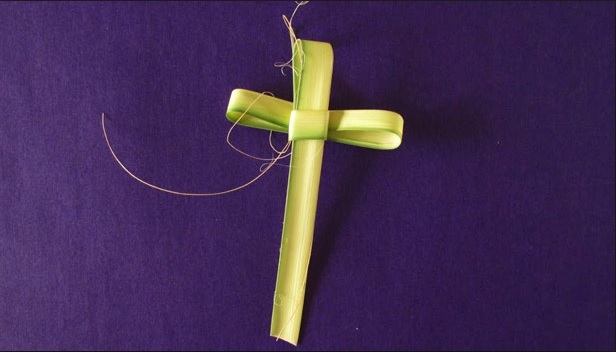
Palm Sunday is one of the two church messages that I remember from elementary school. We all received Crosses made from palm fronds, like the one in the image above. Palm fronds were decorating the interior of the grand Christchurch Cathedral in Newcastle, Australia.
The scene is Jesus riding into Jerusalem, his humble steed adorned with cloaks, the crowds waving palm fronds and singing Hosanna!
However, some of the details and imagery of the Triumphant Entry are perplexing.
In those days, you would expect the king to be riding some huge warhorse. Why would a triumphant King be rolling into town on a baby donkey?
When they brought the colt to Jesus and threw their cloaks over it, he sat on it.
Mark 11:7
This is a direct fulfillment of a prophecy from hundreds of years prior to Christ walking on Earth.
Rejoice greatly, O daughter of Zion!
Shout aloud, O daughter of Jerusalem!
Behold, your king is coming to you;
righteous and having salvation is he,
humble and mounted on a donkey,
on a colt, the foal of a donkey.
Zechariah 9:9
This prophecy, speaking of the coming King, was how we could identify him as the Messiah.
He would be willing to ride on the foal of a donkey, humble himself, and not demand us to acknowledge his power, even though it was significant.
Right after he entered Jerusalem, he went and cleared out the Temple in a display of his power and righteous anger.
He could be both strong and weak, seemingly opposite characteristics, at the same time, which makes him the Messiah.
Another detail of the story is that people would be singing to him and celebrating. Praising him and giving him the honor for who he was.
“Hosanna!”
“Blessed is he who comes in the name of the Lord!”
“Blessed is the coming kingdom of our father David!”
“Hosanna in the highest!”
Mark 11:9-10
In the midst of this spontaneous celebration, I don’t assume that those celebrating understood the suffering and the price Jesus would pay to usher in the kingdom.
The teenage boy in me wonders if they were truly celebrating him, or making fun of him. Before he was crucified, many mocked and scorned him.
Jesus in the Triumphant Entry ushers in Holy Week, and we all know how that week turned out for Jesus and us.
It was because Christ was willing to be humbled, that he was exalted.
It was in his ability to be weak that he was mighty.
Christ is both the Lion and the Lamb
Similar imagery as the triumphant King riding on a foal is what John saw in his vision of the Kingdom of God that is documented in the book of Revelation.
“Do not weep! See, the Lion of the tribe of Judah, the root of David, has triumphed…Then I saw a Lamb, looking as if it had been slain, standing in the in the center of the throne. Revelation 5:5-6
When John sees the throne he sees not only a mighty lion but also a lamb that was slain.
Jesus is triumphant because he was able to surrender.
How do we make this a reality in our lives?
We are made in the image of God, yet Christlikeness is continually being formed in us. What’s more, this is not something that we need to do ourselves, but something that Christ has done for us. We are triumphant with him!
The Apostle Paul struggled with this reality in his own life, and God said to him:
“My grace is sufficient for you, for my power is made perfect in your weakness.” Therefore I will boast all the more gladly about my weaknesses, so that Christ’s power may rest on me. That is why for Christ’s sake, I delight in weaknesses, in insults, in hardships, in persecutions, in difficulties. For when I am weak, then I am strong.
2 Corinthians 12:9-10
Does this mean you have to be self-deprecating and criticize or belittle yourself? Not at all. I am not saying that you should publish to the world all the character flaws you carry or broadcast all the stupid mistakes you have made.
But to a small circle of trusted people, you need to bring these things into the light. We all have hard parts of ourselves that we wish were not so. By bringing them out into the open, as opposed to trying to ignore them, is the only way to reduce the power that they have over you.
Allow others to speak into your life
We all get confused about how we see ourselves compared to how others see us. An interesting study of this dynamic found that 80% of drivers would rate themselves as above average drivers. Which is a mathematical impossibility! (Source)
Allowing others not only to tell you the wonderful things, but also the difficult parts of your character is an incredibly venerable proposition. When you ask someone “How do you see me?” you are allowing someone to give you a blow to your ego.
And it takes a lot of courage to listen and accept this feedback. This can only happen with people you deeply trust, and when you invite them to give you feedback.
Asking for help.
Many leaders tend to come across as if they have it all figured out. People come to us for help. That a place where we get self-worth. We help others; we don’t get helped…
In her book, Rising Strong, Brene Brown gave an insight into our unwillingness to ask and receive help from others:
When you judge yourself for needing help, you judge those you are helping. When you attach value to giving help, you attach value to needing help. The danger of tying your self-worth to being a helper is feeling shame when you have to ask for help. Offering help is courageous and compassionate, but so is asking for help.
Brene Brown
To the degree we are unable to ask for help, is the degree we judge others for needing help.
We all have emotional and relational needs. If we are honest with ourselves, we would rather help others as opposed to asking others to meet your needs.
—
Once God has spoken;
twice have I heard this:
that power belongs to God,
and that to you, O Lord, belongs steadfast love.
Psalm 62:11-12
—